About the calls
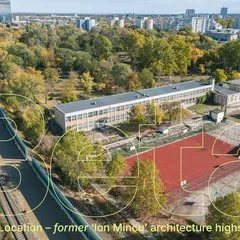
The 2026 edition launches with three open calls inviting architects, designers, artists and interdisciplinary teams to engage directly with the former ‘Ion Mincu’ Technical College, the main venue of the upcoming biennial.
Under the theme In Practice – as opposed to ‘in theory’, the building becomes a working ground rather than an exhibition backdrop. A place where ideas are tested on site, interventions built with what is already existing, and where the boundaries between research, construction, content and public space become fluid.
The calls propose three distinct modes of involvement:
Call 1: Call for Spatial Repairs and Transformative Interventions
Built interventions that repair, question, or transform the building’s interior spaces. Participants are invited to propose potentially permanent gestures that reactivate rooms, rethink circulation, or introduce new spatial relationships.
Call 2: Call for Thresholds and Transitions
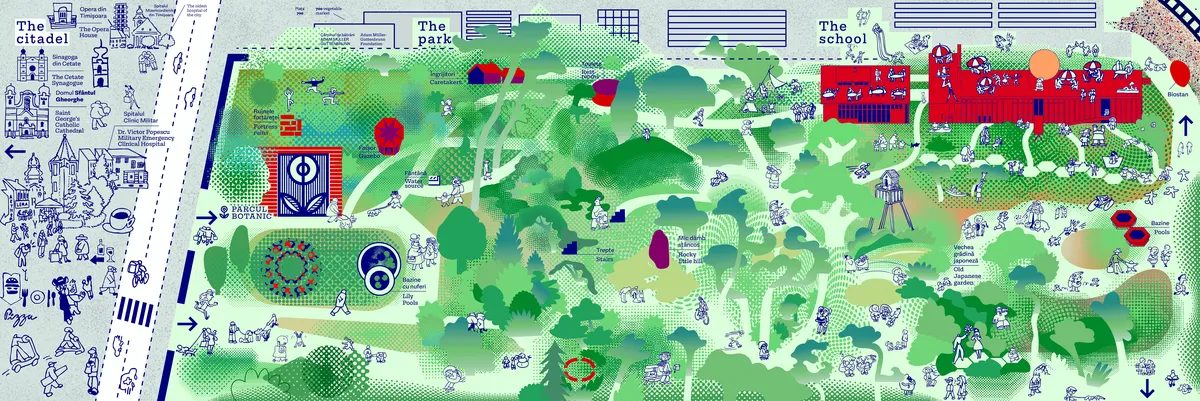
Interventions for the outdoor and in-between areas: entrances, paths, courtyards, edges toward the Botanical Park. The call focuses on structures that connect people, circulation and landscape, also beyond the duration of the biennial.
Call 3: Office in Residence
A six-week relay of on-site residencies. Each team occupies the former canteen for one week, developing research on a specific aspect of the building’s transformation and discussing findings publicly before handing over to the next team.
All three calls embrace architecture as an evolving process: one that is collaborative, open-ended, and grounded in the material realities of an existing building.
Submission deadline: 8 December 2025, 23:59 EET
Shortlist conversations: 16–17 December 2025
Submissions are now closed. Thank you!
Questions
Clarifications for the questions received until November 25
How many projects are selected per call / in total? As outlined in the call, we aim to select 5–8 proposals through Call 1, around 3 through Call 2, and 3 'offices' for Call 3. The final number depends on the quantity and quality of submissions. We also aim for a balanced mix of local, national and international participants, although the final distribution cannot be guaranteed in advance.
Is the call intended for foreign practices and organisations? Absolutely. We warmly welcome international teams. We also appreciate proposals that plan to collaborate with local partners, associations or communities.
How many people can form a participating team? There is no limit on the number of people, but please note that if we need to organise travel, we can cover accommodation and transportation costs for a maximum of 2 people per team.
If I apply as part of a team, can I also submit an individual proposal to the same call or one of the other two? Yes, but the chances of selecting the same team for all calls are very slim. We encourage you to choose carefully and focus your resources (especially time) on a single type of proposal.
The guidelines mention a budget for the project of 5.000 €, but it seems that there is no travel / accommodation / ‚design fee‘ foreseen. Hence my question if the call focuses on local applicants. The fun of such a project for us would be largely linked to going to Timisoara, meeting new people, building things together, discuss and exchange. The 5,000 € is an overall budget estimation for projects of Call 2 (Thresholds and Transitions). Depending on the proposal and the size of the team, we will decide together how to allocate it between production, fees and logistics. We will also seek additional funding where needed. The organisers can cover travel and accommodation costs for up to two people per team (travel from within Europe). For teams coming from outside Europe, a similar maximum amount (1,000 € per team) can be offered, with any difference to be covered individually.
Can interventions be proposed for Call 1 and 2 inside the space in building A (canteen), or will this be occupied exclusively by teams from Call 3? Considering that it will mainly be used for the offices in residence, further proposals can be made, for example, for the former kitchen area or for outdoor or circulation areas. However, ideally, we would like to focus on buildings B and C here.
Is Call 3 open to teams of students/recent graduates or to registered offices? The call is aimed primarily at already formed teams that have the capacity to lead a week-long residency. We expect young graduates and students to participate in the residency activities. Our plan is to form mixed teams (international + local) that are particularly interested in a specific topic.
The required deliverable specifies "One A4 page stating the chosen theme." Does this mean that a comprehensive description of the chosen theme, the concept behind it, and how it will be explored is expected? No exhaustive description is needed; the guidelines list a number of possible topics - facades, circulation, etc. You can propose new ones.
Can the materials and objects (tables, chairs) in the buildings be used for proposals? If necessary, can the objects be dismantled? The new, colourful (blue, green) plastic furniture cannot be used and will be moved to another location. The old wooden and metal furniture can be used, dismantled, transformed, etc.
Can the fence separating the built complex from the park be modified? For example, can elements of the metal fence be removed to allow passage from one side to the other? Yes, you can propose changes to the fence.
Is the perimeter of the plot shown on the site plan limiting us? Or can the intervention exceed it? The perimeter does not limit proposals.
How should these interventions meet the fire protection law? Can at least one of the existing staircases become open? Obtaining the necessary authorizations/permits is the responsibility of the organiser. Proposed solutions can be discussed later, on a case-by-case basis. However, all applications must comply with applicable laws and regulations.
Should the interventions be specific (e.g., targeting a single room) or can they occupy several spaces in the building? Applicants are free to propose whatever they consider appropriate for the building.
Should the desired interventions allow for the subsequent use of the room (leaving space available) or can/should they occupy the entire room? If the proposal is sufficiently convincing and suitable for the location, it may remain in the space after the exhibition has ended, occupy an entire room, or be moved, depending on the specifics of the installation.
Does Call 1 refer to proposals for interventions in the form of seating areas/display systems/markings on walls and floors/installations with which the public can interact? It would be helpful to have a clearer delineation of the relationship that the desired interventions will have with the rest of the exhibition. Are interventions intended to support the exhibition or interventions that are part of the exhibition desired? The calls are designed so that we can explore various methods of integrating your ideas. The two stages of the call allow us to define the proposal more clearly in phase 2 and integrate it into the exhibition. Interventions can be part of the exhibition, but they can also have a utilitarian character.
Are proposals specifically sought for the outdoor space adjacent to the botanical park or adjacent to the main entrances? You can refer to any side of the complex; the relationship with the park is the most promising, but you can refer to the entire site, in any direction.